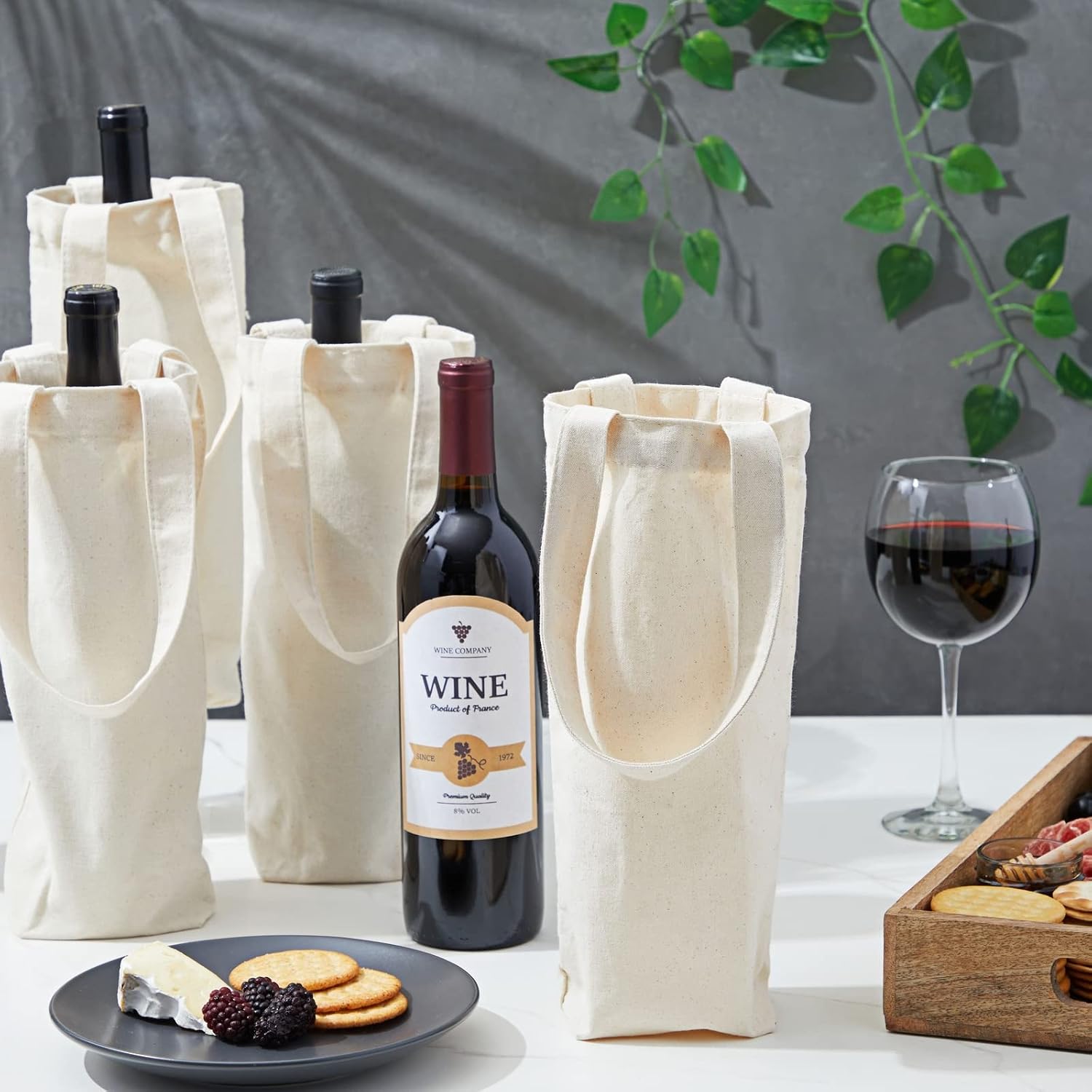
Welcome, and glad you’re here — especially if you’ve ever arrived at a dinner party gripping a bottle by the neck, or handed over a beautiful Pinot wrapped in a gas-station paper bag. You deserve a better system, and so does the wine.
A canvas wine tote bag is exactly what it sounds like: a fabric carrier — usually made from cotton canvas, the same sturdy woven material used in backpacks and market bags — designed to hold one, two, or more wine bottles securely. The “canvas” part matters because it signals washability, packability, and low maintenance, as opposed to leather or neoprene carriers that require more careful handling. These bags sit in the $12–$40 price window for most shoppers, live in your car trunk or kitchen drawer, and get used constantly: grocery runs, dinner invitations, picnics, bottle shops. If you’ve already got one or two and are wondering whether to upgrade or add a second configuration, you’re in the right place. This guide compares the real tradeoffs — divider systems, handle construction, weight, cleaning — and ends with a clear decision rule so you can stop second-guessing.
Why Canvas Has Become the Default for Everyday Wine Carrying
The premise is simple: you need a bag that’s good enough to protect a $25 bottle on a ten-minute car ride, presentable enough to hand off at a dinner party, and durable enough to survive a year of weekly use without looking wrecked. Leather and insulated neoprene carriers do more, but they also cost more, weigh more, and require more care. Canvas does about 90% of the job at 20% of the price.
That math is validated consistently across category reviews. Wine Enthusiast’s buying guide notes that canvas totes dominate the sub-$40 segment precisely because the material is forgiving — it handles structural stress from bottle weight better than non-woven polypropylene alternatives and cleans up without special products. Real Simple’s overview of reusable bags makes a similar point: heavy-duty cotton canvas (typically 10 oz. to 12 oz. fabric weight) resists fraying at stress points significantly longer than lighter blends, especially at handle attachment seams.
The everyday-carry argument is also environmental. Apartment Therapy’s feature on stylish reusable bags worth keeping visible noted that canvas bags with a clear use-case — wine carrying, specifically — get used more frequently than generic totes, which means fewer impulse plastic bag grabs at the store. For buyers who care about that, it’s a real secondary benefit, not just marketing copy.
The Tradeoffs That Actually Matter at This Price Point
Here’s where intermediate buyers separate from first-timers: you already know what a canvas tote is. The question is which specific configuration to buy and why. Four variables drive almost every decision.
1. Divider System: Padded vs. Cardboard vs. None
The most consequential structural choice is how bottles are separated from each other inside the bag.
Cardboard dividers are the most common configuration in the $12–$22 range. They’re adequate when dry, but owners consistently report that a single liquid spill — whether from condensation on a chilled bottle or an actual cork leak — renders them soft and useless within a season. If you’re buying for the car trunk and will occasionally carry chilled bottles, cardboard dividers are a recurring replacement cost disguised as a one-time purchase.
Padded fabric dividers — typically a quilted cotton or thin foam insert stitched into channels — cost a bit more to manufacture and show up in bags priced from about $25 upward. Owners across aggregated reviews flag these as the single biggest quality upgrade: they don’t collapse when wet, they add light cushioning for road vibration, and they can be wiped clean rather than replaced. The Spruce Eats’ wine accessories roundup specifically calls out padded dividers as the feature that separates “gift-ready” canvas totes from “grocery-run” ones.
No dividers (open-body totes) work for single-bottle gifting situations where presentation matters — the bottle sits inside a clean canvas bag with a ribbon, essentially — but they’re not practical for multi-bottle everyday carry. If you’re evaluating a no-divider bag for trunk use, skip it.
2. Handle Construction and Load Rating
A two-bottle canvas tote carries roughly 5–6 lbs. when full. A six-bottle version hits 15–18 lbs. The handles need to be built for that, and most aren’t.
Look at two things: the handle material and the attachment method. Twisted cotton rope handles look beautiful but stretch and fray under repeated heavy loads — multiple owner reviews on mid-range bags describe rope handles that became uncomfortably thin after six months of weekly grocery-plus-wine use. Flat webbing handles (cotton or polypropylene) hold their shape and distribute weight more evenly across your palm.
Attachment matters more than handle material. Bar-tack stitching — a dense, wide stitch pattern that distributes load across a patch of fabric — is the standard in well-built bags and is visible on the exterior of the handle junction. Single-line stitching at the handle attachment point is a failure indicator; it’s the first seam to go. Good Housekeeping’s canvas bag care guide notes that handle seam failure is the primary end-of-life cause for canvas totes, not the body fabric itself.
3. Bag Sizing: Two-Bottle vs. Four-Bottle vs. Six-Bottle
By the numbers:
- Two-bottle tote: typical dimensions 7”W × 13”H × 4”D; weight capacity ~6 lbs.; best for dinner party gifting or single-trip carry
- Four-bottle tote: ~11”W × 13”H × 5”D; ~12 lbs. capacity; the trunk workhorse for most weekend entertainers
- Six-bottle tote: ~14”W × 13”H × 6”D; ~18 lbs. at capacity; optimal for bottle-shop runs but requires bar-tack handles (see above)
The four-bottle format is the highest-utility choice for most readers at this stage. It handles the typical “we’re bringing wine to the party” scenario (two bottles), the “I stopped at the shop on the way” scenario (three to four bottles), and doubles as a structured grocery carrier on every other trip. Two-bottle bags are more giftable but less useful daily. Six-bottle bags are excellent if you buy by the case and break it down for sharing, but the handle and body construction have to be up to the weight — a $15 six-bottle bag is a bad buy; a $35–$40 one from a brand with verifiable bar-tack construction is a reasonable one.
4. Washability in Practice
This is the feature that earns the “reusable” label or quietly undermines it.
Canvas itself washes well. The failure points are the dividers, any printed graphics, and the handles. Good Housekeeping’s care guide recommends cold-water machine washing for plain canvas totes and notes that heat — dryers specifically — is the primary cause of graphic cracking and handle shrinkage. The practical takeaway: if you’re buying a canvas wine tote you plan to machine wash (which you should, regularly), choose one with stitched or embroidered branding rather than screen-printed ink, and air-dry flat.
Bags with removable divider inserts are meaningfully better than those with fixed dividers for washing purposes. You pull the insert out, wash the bag body flat, wipe the insert separately, and reassemble. Owners who use canvas totes as weekly trunk fixtures consistently cite removable inserts as the detail that makes the habit sustainable.
What Real Owners Say About Specific Use Cases
Across aggregated reviews of canvas wine totes in the $15–$40 range, a few patterns hold consistently:
For the car trunk: Owners favor darker canvas colors (navy, olive, black) over natural or white, because trunk grime and bottle drips show immediately on light fabric and survive washing imperfectly. A color that reads as “intentionally casual” ages better than one that reads as “stained.”
For gifting: The two-bottle canvas tote with a gussetted base (a flat bottom panel that lets the bag stand upright) gets the strongest repeat-purchase reviews for dinner party host gifts in the $20–$30 range. The Wine Enthusiast guide highlights that a standing tote with clean stitching and rope or ribbon handle reads as intentional and elevated without requiring a $50+ leather carrier.
For bottle shops and grocery runs: Owners consistently flag that the bag needs to fold flat when empty — a non-negotiable for trunk storage. Structured bags with thick base inserts don’t collapse and take up disproportionate space. Look for bags described as “foldable” or “lay-flat” in the product specs.
The Decision Rule
You’re choosing a canvas wine tote for everyday use. Here’s how to cut through it:
If your primary use is the car trunk for weekly runs: Buy a four-bottle canvas tote in the $28–$38 range with padded fabric dividers, bar-tack handles, and a foldable body. Prioritize construction details over aesthetics. Dark colorways will serve you longer.
If your primary use is dinner party gifting: Buy a two-bottle tote with a gussetted standing base and a cleaner, more elevated presentation — rope handles, minimal branding, natural or linen-look canvas in the $18–$28 range. The bag is part of the gift, so it should look like it is.
If you want one bag that does both: The four-bottle format wins again, but look specifically for a bag with a removable divider insert so you can use it as an open carrier when bringing a single decorated bottle and as a structured tote when loading up at the bottle shop.
If you’re considering a six-bottle canvas tote: Only buy up if the price is at least $32–$40 and the brand explicitly calls out reinforced handle attachment. At $15–$20, the construction won’t survive the weight long enough to justify the cost savings.
Canvas wine totes are a small purchase with a disproportionately large quality-of-life return when you get the configuration right. The wine lands safely, the bag washes clean, and you stop showing up to things empty-handed or over-apologizing for the presentation. That’s the whole deal — and it’s well within reach.