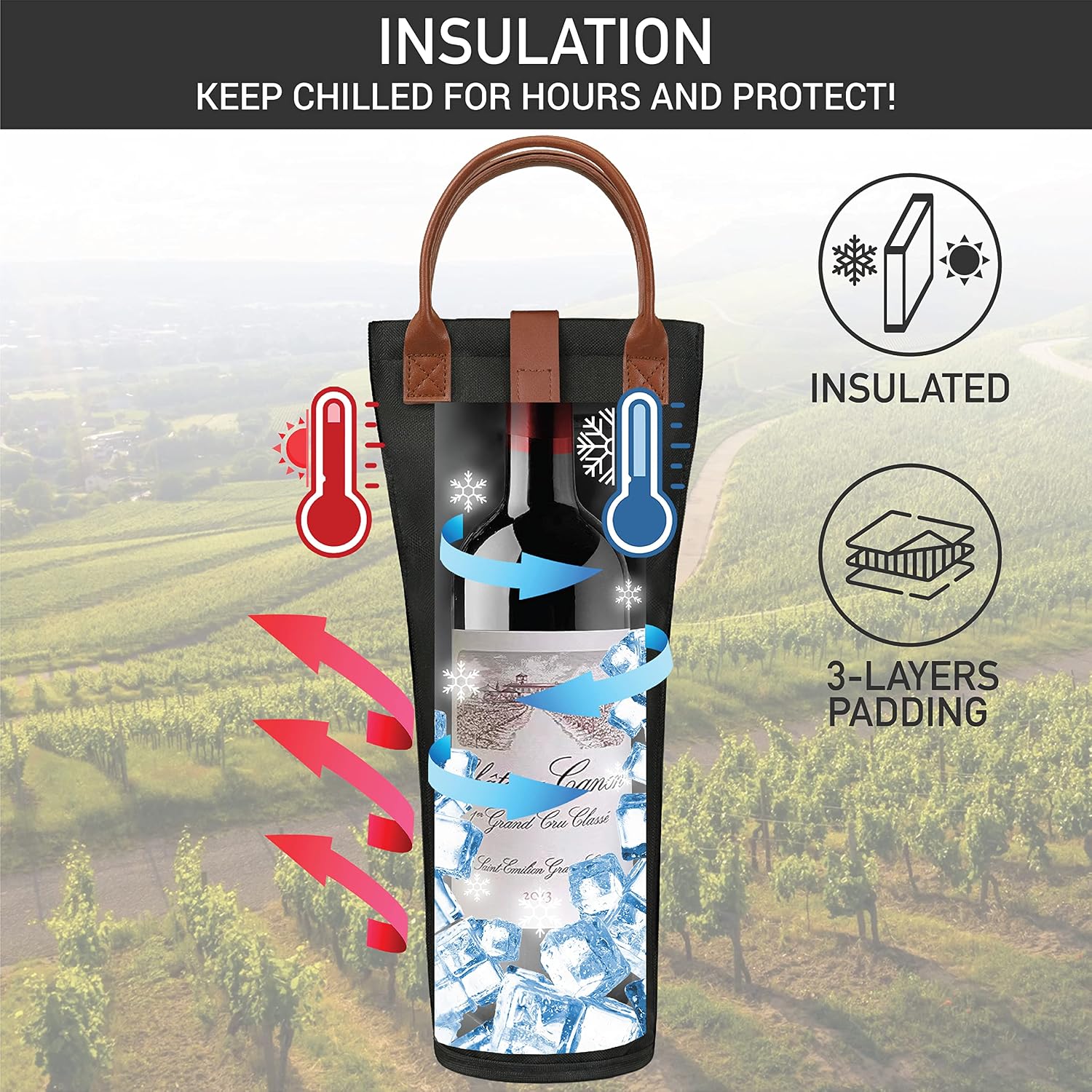
Welcome, and let’s start with the honest version of a question you’ve probably already asked yourself: does insulation actually matter in a wine tote, or is it mostly marketing? If you’ve bought one tote, used it once at a summer picnic, and watched a Sauvignon Blanc climb from fridge-cold to lukewarm in under an hour, you already know the answer. Insulation matters enormously — but what kind of insulation, and how much of it, makes a difference that’s almost impossible to detect on a product page. This guide breaks down the three dominant insulation approaches on the market right now: neoprene (the stretchy, wetsuit-style material that wraps individual bottles snugly), canvas with a foil-lined interior (the most common construction in the $15–$45 range), and padded cooler-style bags (rigid or semi-rigid builds with thick foam walls, closer to a soft-sided cooler than a traditional tote). Each has a legitimate use case. Each has a tradeoff the product listings don’t always flag. By the end, you’ll have a clear decision rule for which one fits your situation.
| EDITOR'S PICK[Wine Enthusiast 6-Bottle Waxed](https://www.amazon.com/dp/B078L69D85?tag=greenflower20-20)… | Mid-tier[Tirrinia 2 Bottle Leakproof Ins](https://www.amazon.com/dp/B077LTK8VS?tag=greenflower20-20)… | Budget pick[BUILT 2B-BLK 2-Bottle Stain Res](https://www.amazon.com/dp/B00015COUS?tag=greenflower20-20)… | |
|---|---|---|---|
| Capacity | 6 bottles | 2 bottles | 2 bottles |
| Material | Waxed canvas | — | Neoprene |
| Ice pack incl. | ✓ | — | — |
| Leakproof | — | ✓ | — |
| Stain resistant | — | — | ✓ |
| Price | $79.95 | $20.99 | $18.99 |
| See on Amazon → | See on Amazon → | See on Amazon → |
Why Insulation Type Is the Decision That Matters Most
If you’ve been shopping this category for more than a few weeks, you’ve noticed that “insulated” on a product listing can mean almost anything — from a thin foil layer bonded to a cotton canvas exterior, to 10mm closed-cell foam sandwiched between neoprene panels. The word is not regulated and not standardized across the industry.
The practical variable is dwell time: how long will the wine be outside refrigeration before it’s poured? That single number should drive your material choice more than price or aesthetics.
Here’s a benchmark framework based on aggregated owner reports and manufacturer-stated ratings across the category:
| Material | Typical insulation thickness | Reported hold time (chilled wine, 75°F ambient) |
|---|---|---|
| Neoprene sleeve | 3–5mm | 1–2 hours |
| Canvas + foil lining | 4–8mm combined | 1.5–3 hours |
| Padded cooler-style | 10–20mm foam | 3–6+ hours |
Note: These ranges reflect owner-reported experience and manufacturer guidance across multiple product lines. Actual performance varies by ambient temperature, pre-chilling, and bottle fill level.
The gap between the top and bottom of that table is not trivial. If you’re walking a bottle from your car to a restaurant private dining room — maybe ten minutes — neoprene is fine and the slim profile is genuinely useful. If you’re setting up a three-hour lawn event in May with no access to a bar cooler, you are under-equipped with anything below the padded cooler tier.
That sounds obvious in retrospect, but roundup coverage in Real Simple’s “Best Wine Tote Bags for Every Occasion” consistently flags this mismatch as the single most common buyer regret in the category: people buy on aesthetics or price, underestimate their actual dwell time, and end up with warm wine at exactly the moment it matters.
Three Materials, Three Use Cases
Neoprene Totes: The Honest Case For and Against
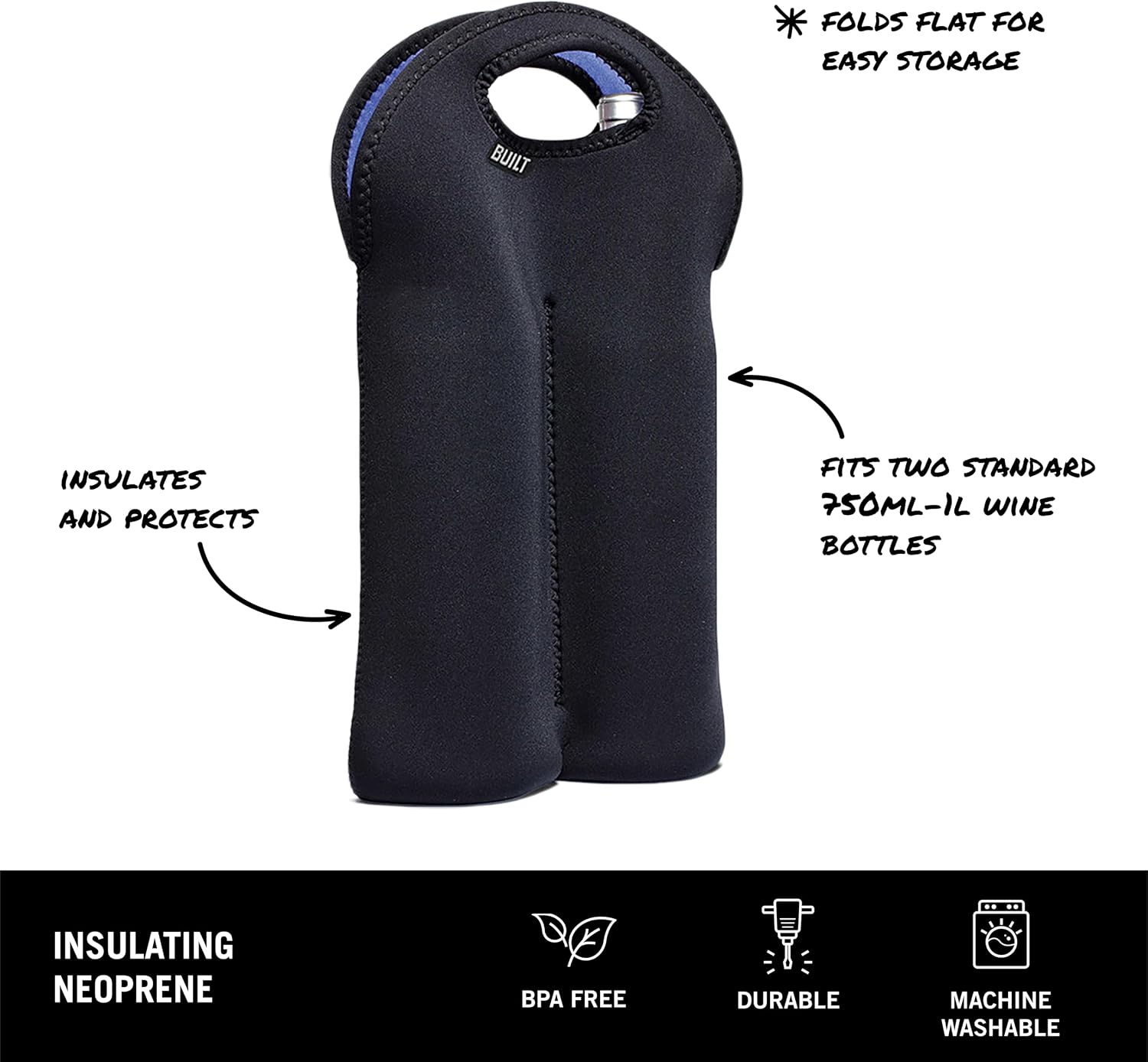
Neoprene wine sleeves and totes have a loyal following, and the reasons are legitimate. Coverage in The Spruce Eats’ “Best Insulated Wine Carriers” highlights neoprene’s core strength: it’s a compression-fit material that conforms to the bottle and creates a seal with almost no dead air space. Dead air inside an insulated bag is actually a liability — it’s ambient-temperature air that conducts heat toward your bottle. Neoprene minimizes that problem by design.
Owners consistently report that neoprene performs better than its thickness suggests for short windows, specifically because of that conforming fit. A 4mm neoprene sleeve on a pre-chilled bottle will outperform a loosely packed canvas tote with nominal 6mm foil insulation for the first 60–90 minutes.
Where neoprene loses the argument:
- It doesn’t scale well. Neoprene two-bottle totes are the practical limit before the material becomes too heavy and inflexible to carry comfortably. For six-bottle transport — a common need for corporate gifting or event activation — neoprene is almost never the right call.
- It shows wear. Long-run owner feedback aggregated in Good Housekeeping’s “Best Wine Tote Bags, Tested and Reviewed” notes that neoprene compresses and loses resilience over 12–18 months of regular use, especially if it’s been machine-washed repeatedly.
- The aesthetic ceiling is real. If presentation matters — and for gift-giving or professional contexts, it does — neoprene reads as utilitarian. It doesn’t photograph well for branding applications and it doesn’t age gracefully the way canvas or leather does.
Best fit: Short-carry personal use. One or two bottles, 90 minutes or less outside refrigeration, casual context. At the $15–$30 price point, it’s hard to argue against for this specific use case.
BUILT
$18.99
In stock on Amazon
Check price on AmazonCanvas and Foil-Lined Totes: The Workhorse Tier
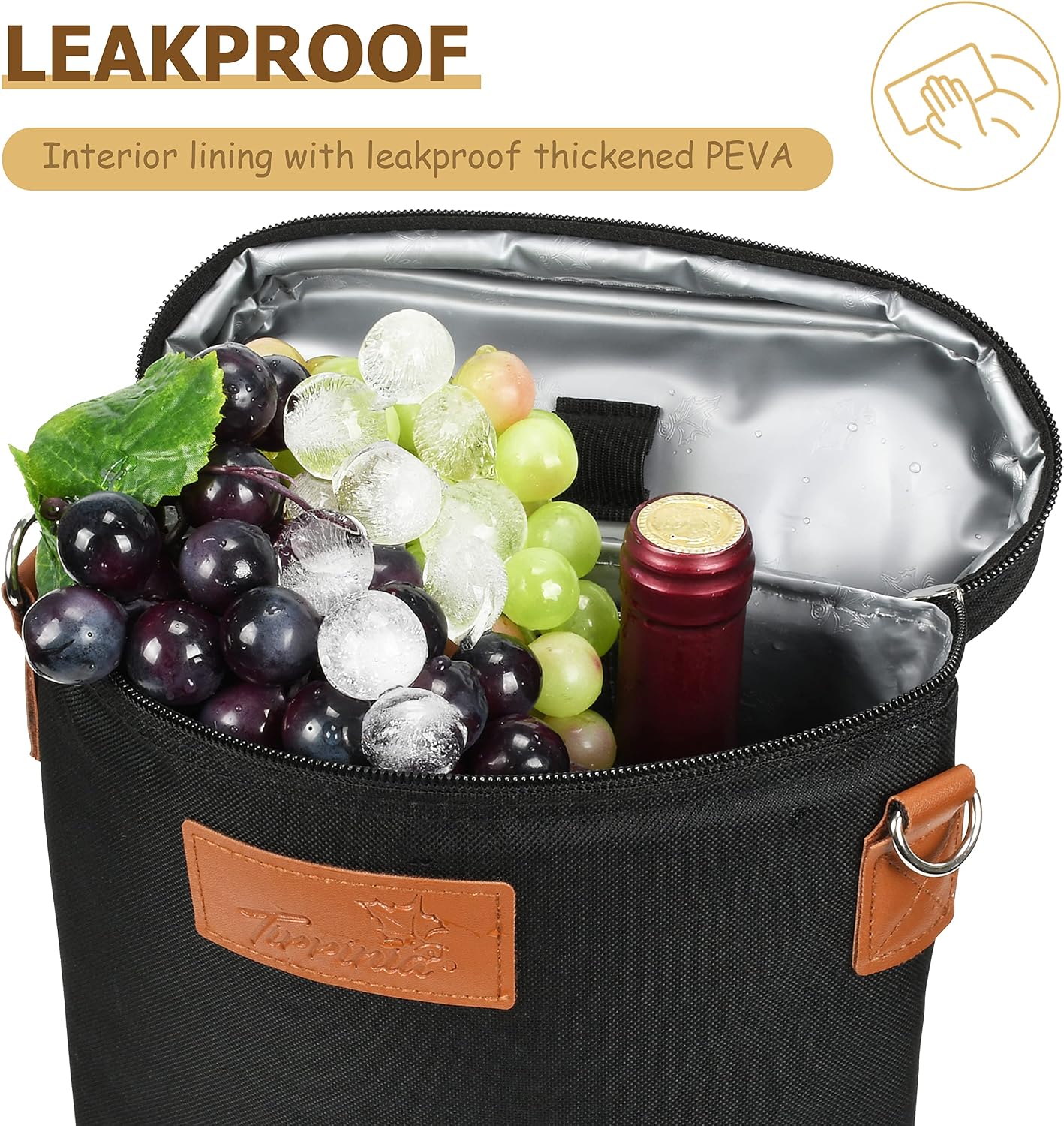
This is the volume center of the market — the $18–$55 range where most casual buyers, picnickers, and gift-seekers land. Canvas exteriors with foil-lined interiors (sometimes reinforced with a thin layer of polyethylene foam) represent the broadest SKU range and, honestly, the broadest performance range too.
The variable that separates a good canvas tote from a mediocre one isn’t the canvas — it’s the foil construction. Apartment Therapy’s “How to Keep Wine Cold on a Picnic” makes a useful distinction: bonded foil (where the reflective layer is glued directly to the fabric) degrades faster and insulates less effectively than a quilted or bubble-cell foil insert that creates a separate thermal layer. Owners report that bonded foil totes start cracking and delaminating within a season of regular use, which also compromises insulation over time.
What to look for in this tier:
- Removable foil insert. This signals more serious construction and allows the exterior to be wiped or spot-cleaned without damaging the insulation layer.
- Sealed side seams. Many canvas totes at the lower end of this tier are sewn through the insulation layer, creating thermal bridges at every seam. Taped or heat-sealed seams — common in the $35-plus range — meaningfully reduce this.
- Divider construction. For multi-bottle totes, padded individual dividers matter. A six-bottle tote with a single foil-lined cavity and no internal structure protects the perimeter bottles far better than the center ones.
Good Housekeeping’s “Best Wine Tote Bags, Tested and Reviewed” consistently elevates brands that address all three of these construction details — and consistently flags “felt-lined only” or “single-layer foil” builds as the ones that disappoint in real use.
The tradeoff to name explicitly: Canvas totes in this tier look great and carry well. For a two-hour outdoor lunch in mild weather, they’re genuinely sufficient. Push them past three hours in high heat, or expect them to hold a full six-bottle load through a four-hour event, and you’re asking more than the construction supports.
Best fit: The 1.5–3 hour window, outdoor entertaining, gifting contexts where presentation matters as much as performance, single or two-bottle everyday carry in the $20–$45 range.
Tirrinia
$20.99
In stock on Amazon
Check price on AmazonPadded Cooler-Style Bags: When You’re Playing a Different Game
This is the tier where the performance conversation changes register. Padded cooler-style wine totes — semi-rigid builds with 10–20mm closed-cell foam walls, waterproof liners, and often a top-loading zippered closure rather than open-top tote handles — are built around a fundamentally different design principle. They prioritize thermal mass and seal integrity over portability and aesthetics.
Wine Enthusiast’s “Insulated Wine Bag Buying Guide” places structured insulated carriers in this category as the correct choice any time dwell time exceeds three hours, or when ambient temperature is above 85°F. The physics reason is straightforward: thicker foam walls slow the rate of heat transfer, and a sealed zippered enclosure prevents warm air from cycling in and out the way an open-top tote allows.
Owners who use these for picnics, beach outings, and extended outdoor events report holding pre-chilled white wines at or below 55°F for four to six hours in warm conditions — a result that’s simply not replicable with canvas or neoprene. Several premium options in the $65–$120 range pair the insulated bag construction with shoulder straps and structured bases, which meaningfully changes the ergonomics for longer carries.
Where this tier creates friction:
- Bulk and weight. A six-bottle padded cooler tote with wine inside will run 10–14 lbs. That’s a meaningful load for a walk from a parking lot to a picnic site. Owners in long-run reviews frequently note that the weight is fine for short carries but fatiguing for anything over 10–15 minutes of walking.
- Presentation. These bags don’t read as gifts out of the box. They look like what they are — high-performance carriers — which is exactly right for the serious collector, but less right for a bachelorette gift or corporate presentation context where the bag itself is part of the impression.
- Price ceiling. At the top of this tier ($120–$200), you’re in the same budget as entry-level structured leather totes that offer comparable or better temperature performance with a far better aesthetic profile. The cost-per-use math only favors the cooler-style bag if you’re using it frequently in genuinely demanding conditions.
Best fit: Three-plus hours of outdoor exposure, high ambient temperatures, transporting bottles you genuinely care about keeping within serving range, or frequent picnic and event use where function beats presentation.
Wine
$79.95
In stock on Amazon
Check price on AmazonThe Decision Rule: Match the Bag to the Clock
Here’s the framework distilled into a clear if/then structure:
If your bottles are outside refrigeration for 90 minutes or less — a neoprene sleeve or single-bottle carrier handles this completely. Don’t overspend. The $15–$28 range covers you.
If you’re in the 1.5–3 hour window — a well-constructed canvas and foil-lined tote is your natural home. Prioritize sealed seams, a removable insert, and padded dividers. Budget $30–$55 for a two-bottle version; $45–$75 for a quality six-bottle build.
If you need four-plus hours, or you’re working in summer heat above 85°F — step up to a padded cooler-style bag. The performance gap at this duration is real enough that saving $30 on a canvas tote is a false economy. Budget $65–$120 for a solid performer in this tier.
If presentation is the primary driver — for gifting, corporate branding, or event activation contexts — the material choice becomes secondary to construction quality and finish. A well-made canvas tote at $55–$80 will outperform a cheap neoprene or foam bag on every dimension that matters in those contexts, including how it photographs and how it reads as a gift.
As both The Spruce Eats’ “Best Insulated Wine Carriers” and Real Simple’s “Best Wine Tote Bags for Every Occasion” note in their respective buying guidance: the category has genuinely strong options at every tier. The mistake isn’t choosing the wrong price point — it’s choosing a material designed for the wrong dwell time. Match the insulation to the clock, and you’ll be right almost every time.