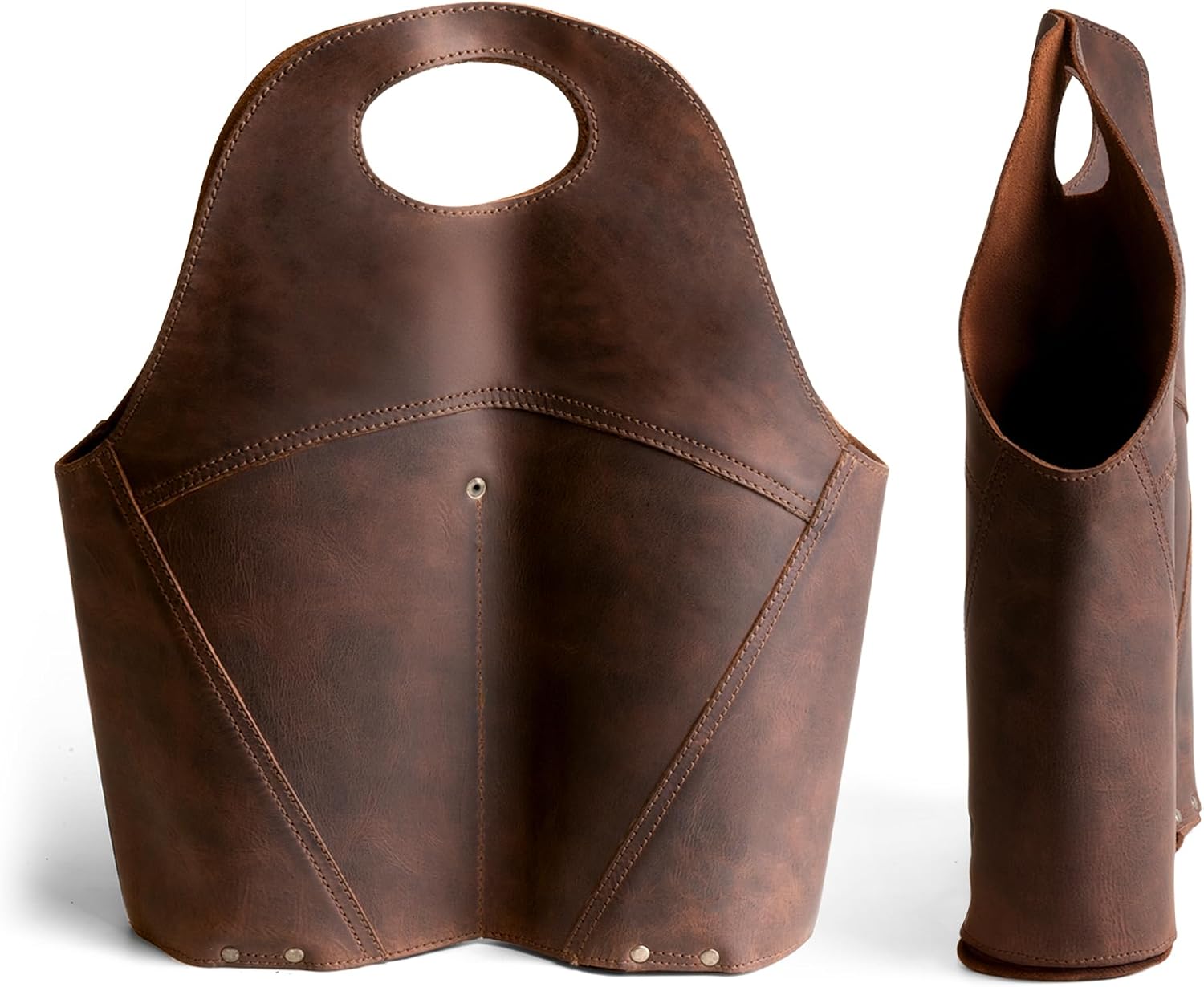
Welcome — and if you’re reading this, you’ve probably already moved past the generic neoprene sleeve phase. You’re thinking about a full-grain leather wine tote (meaning a carrier made from the outermost layer of the hide, which is the most durable and develops a richer look with age, unlike “genuine leather” or bonded leather that splinter and peel over time). You want something that keeps a prized bottle — a cellar-aged Burgundy, a collector Barolo, something that took years to source — safe during the trip from your rack to the table. That’s the specific problem this article solves. We’ll walk through what the specs actually tell you, what long-term owners say about construction quality, and exactly which tradeoffs matter when you’re spending $120–$200+ on a carrier for wines that cost three to ten times that.
This isn’t a casual-picnic piece. If you’re looking for a canvas two-bottle tote for a Saturday farmer’s market, that guide is elsewhere on this site. This one is for the person with a decision pending: you’ve narrowed it down, you’re ready to commit, and you want to know whether the leather, the stitching, and the insulation will actually hold up to real use.
Why Full-Grain Leather and Not Something Else
Let’s name the tradeoff explicitly, because it’s real: full-grain leather wine totes cost more, weigh more, and require occasional conditioning. If those three things are dealbreakers, bonded leather or canvas are valid alternatives. But here’s why serious collectors keep coming back to full-grain:
Durability compounds. Bonded leather — which is essentially leather dust reconstituted with adhesive — begins delaminating at stress points (handles, base corners, zipper edges) within 12–24 months of regular use, per aggregated owner reviews on multiple retail platforms compiled by The Spruce Eats in their carrier roundups. Full-grain leather, properly conditioned twice a year, develops a patina and gets stronger at flex points rather than weaker. Owners of premium carriers like those in Picnic Time’s Heritage Collection consistently report that their bags look better at year three than at purchase.
Thermal performance is structural, not just a liner question. Most serious buyers know to look for an insulated liner — typically food-grade EVA foam or thick closed-cell foam — but what the spec sheets also show is that a structured rigid leather shell dramatically reduces heat transfer from ambient air compared to a floppy canvas exterior. The leather acts as a secondary thermal buffer. Wine Enthusiast’s buying guide specifically calls out structured exterior walls as a meaningful variable in temperature maintenance over 2–4 hour transit windows, which is the realistic use case for most collectors transporting bottles to a dinner or a tasting.
Bottle protection is mostly a construction question. The thing that damages wine in transit isn’t usually temperature — it’s vibration and impact. Full-grain leather totes with padded dividers (look for dense foam or quilted separators, not thin cardboard inserts) show meaningfully better bottle isolation in the spec comparisons that Good Housekeeping ran in their 2025 wine bag roundup. Soft-sided bags transmit shock directly to the bottles; a structured leather shell absorbs and distributes it.
The Specs That Actually Matter (and the Ones That Don’t)
Here’s the practical framework when you’re evaluating options side by side.
Do pay attention to:
- Hide thickness. Spec sheets from reputable brands list this in millimeters or ounces (oz is a US measure of leather weight — 3–4 oz is thin; 5–6 oz is mid-weight; 7–9 oz is substantial). For a wine tote that will see regular use, 5 oz minimum is the threshold worth targeting. Anything labeled simply “genuine leather” without a thickness spec is almost always reconstituted material.
- Divider construction. Removable quilted dividers are preferable to fixed cardboard inserts, both because they can be washed and because they provide better shock absorption. Owners in long-run reviews consistently flag cardboard inserts as the first failure point in cheaper leather-adjacent carriers.
- Handle attachment method. Riveted and bar-tacked handles dramatically outlast handles that are only stitched to the body. Look for double-stitched reinforcement at stress points, or visible metal hardware at attachment points.
- Liner seal quality. A leaky liner isn’t just a mess problem — moisture inside a leather bag damages the shell from the inside out. Food and Wine’s carrier features consistently note that thermal liners with welded seams (rather than stitched seams) hold up significantly better over multi-year use.
Don’t over-weight:
- Exterior brand logos or embossed detailing (aesthetic, not structural)
- Claimed “up to X hours” temperature retention without knowing ambient conditions — these numbers are marketing unless the brand specifies a testing methodology
- Price alone as a quality signal — the $180–$220 range includes both excellent structured carriers and fashion-forward bags with thin leather and minimal insulation
By the Numbers
| Price tier | Typical leather type | Insulation quality | Expected useful life |
|---|---|---|---|
| $40–$80 | Bonded / PU leather | Thin foam liner | 1–3 years |
| $80–$130 | Split leather or thin genuine | Mid-weight EVA | 3–5 years |
| $130–$200+ | Full-grain, 5–7 oz | Dense closed-cell + rigid shell | 7–12+ years |
Based on aggregated spec comparisons and owner review patterns across Wine Enthusiast and The Spruce Eats roundups.
What Serious Owners Actually Report
The pattern across long-run reviews is consistent enough to be useful. Owners of premium structured leather wine totes — the Picnic Time Heritage Collection is one of the most frequently reviewed in this category — report that the break-in period is real: full-grain leather is stiff for the first several uses and the handles may feel tight. This is normal, and it resolves with use and a single conditioning treatment. Buyers who don’t know to expect this sometimes leave early negative reviews that aren’t representative of the product’s actual durability.
The second recurring pattern: owners consistently report that stitching quality shows up fast. Within the first 6–12 months of regular use, any weak seam becomes visible. Brands that use saddle stitching (two-needle, locked stitches that don’t unravel if one thread breaks) show dramatically better long-term seam integrity than machine-chain-stitched alternatives. This is hard to verify visually in product photos, so reading 6–12 month follow-up reviews specifically is more useful than star ratings alone.
The third pattern, flagged in Good Housekeeping’s roundup analysis: buyers who transport bottles in cars during summer consistently report that the insulation quality matters far more than the exterior material. A gorgeous full-grain shell on a thin foam liner will not protect a $150 Burgundy on a 90°F afternoon for more than about 45 minutes. If your typical transit scenario involves a warm car, prioritize thick closed-cell foam liners (12mm or more) and pre-chill your tote before loading.
Coravin’s travel accessories — positioned for collectors transporting opened bottles preserved under argon gas — occupy a specific niche here that’s worth acknowledging. Their carriers are engineered around bottle security for a single bottle in transit, not for the aesthetics of a traditional tote, and owners report they serve that function extremely well. If your use case is single-bottle transport of something genuinely irreplaceable, that’s a different decision tree than a two- or four-bottle structured tote for dinner parties.
The Gifting Calculation (When You’re Buying for Someone Else)
This section is for the buyer who’s sourcing a premium leather wine tote as a gift — wedding, corporate, or milestone occasion — rather than for personal use. The calculus shifts slightly.
Personalization is a meaningful value-add at this price point. Boutique brands like Twine & Todd and Uncommon Goods offer monogramming and embroidery on structured leather carriers, and in the $80–$150 gift budget range, owners consistently report that the personalization element is what elevates the gift from functional to memorable. The practical consideration: allow 2–3 weeks for custom work, and confirm whether the embroidery is applied before or after construction (post-construction embroidery on structured bags sometimes shows distortion at panel edges).
For corporate gifting at volume — typically 10+ units for event activations or client programs — the cost-per-unit math changes. Most boutique brands offer tiered pricing at 12+ units, and the Food and Wine gift guides note that structured leather carriers with subtle debossed branding (rather than screen-printed logos) read as premium rather than promotional, which matters for high-value client relationships. Budget $90–$150 per unit at volume for genuine quality; below that threshold, the leather grade typically drops.
The Decision Framework
If you’ve read this far, here’s the clear if/then breakdown:
If your primary use is transporting 1–2 bottles of genuinely valuable wine (aged, rare, or irreplaceable) over 1–4 hour transits: Prioritize insulation quality and divider construction above all else. A thick closed-cell foam liner (12mm+) and padded individual dividers matter more than exterior aesthetics. Full-grain leather adds durability and structure, but don’t trade liner quality for a prettier shell.
If your primary use is regular entertaining — bringing bottles to dinner parties, tastings, or events several times a month: The full-grain construction pays off over 3–5 years of use. Invest in saddle-stitched seams, riveted handles, and a brand with documented long-run owner reviews. The Picnic Time Heritage Collection sits squarely in this use case and earns consistent long-term praise, per Wine Enthusiast’s category coverage.
If you’re buying as a gift in the $80–$150 range: Personalization is your differentiator. Prioritize brands offering monogramming on genuine (not bonded) leather, and build in 2–3 weeks for custom work. Uncommon Goods and Twine & Todd are both well-regarded in this segment.
If you’re sourcing at volume for corporate gifting: Confirm leather grade in writing before committing — ask for a material spec, not just a product description. Debossed branding over screen print. Budget $90–$150/unit minimum for quality that reflects well on the brand doing the gifting.
If you’re unsure between two options at similar price points: The tiebreaker is almost always the liner. A gorgeous full-grain exterior on a thin liner is a display piece. A solid mid-grade leather shell on a properly sealed, thick foam liner is a working tool. For wine that matters, choose the working tool.
The bottles you’re carrying took years to get where they are. The carrier is the last protection they get before the table — it’s worth getting it right.