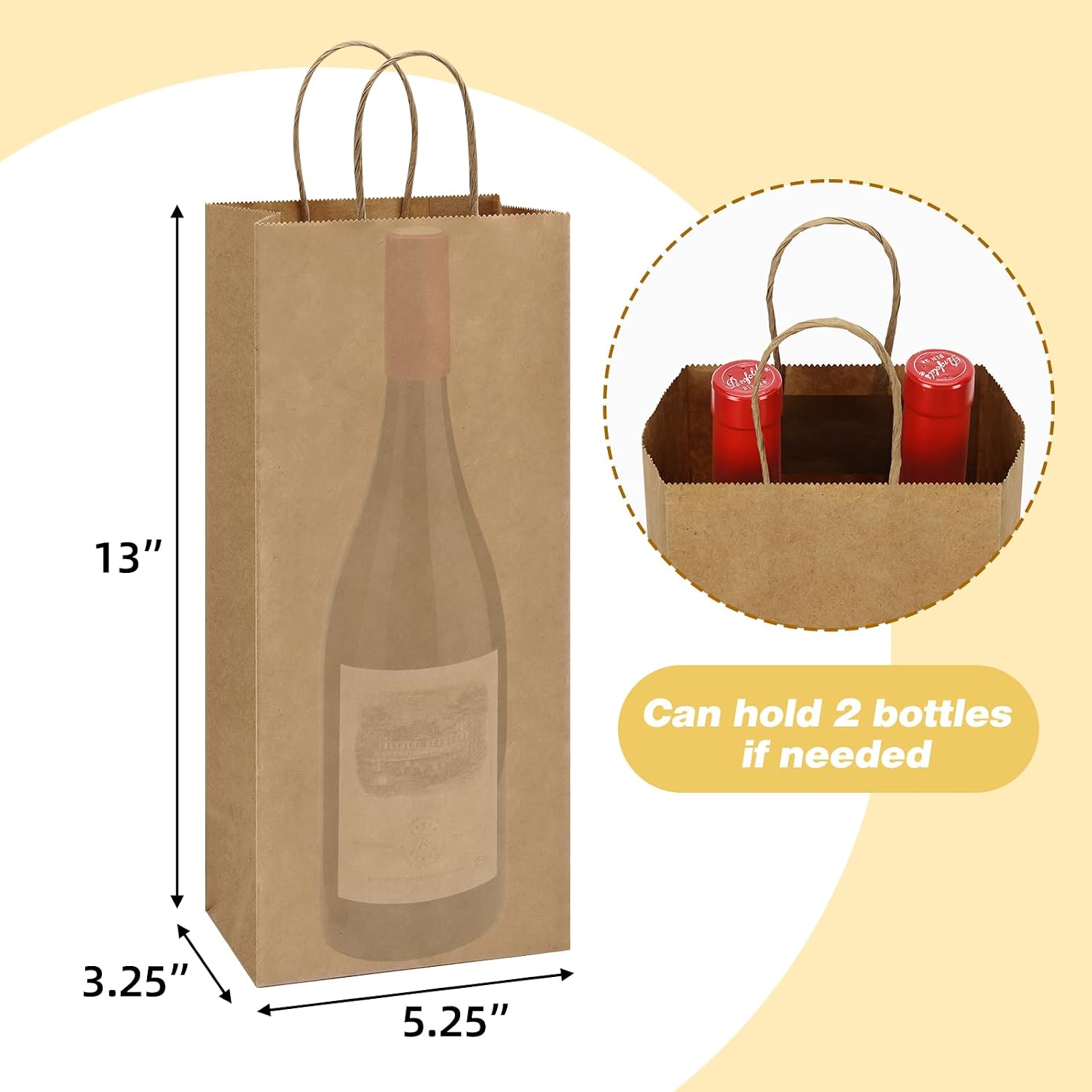
Welcome — and if you’re here, you’re probably staring down a real decision: a corporate gifting event, a retail floor that needs restocking, a wedding with 80 guests, or a holiday party that needs to look polished without wrecking your budget. Paper wine gift bags — the tall, narrow bags sized to hold a standard 750ml bottle — seem simple until you realize there are dozens of variants, and the wrong call at the bulk-buying stage is costly and annoying to reverse. This guide covers the three main styles you’ll encounter (natural kraft, metallic foil, and printed/colorful), explains the material and construction differences that actually matter, and ends with a clear decision framework so you can match your context to the right product.
If you’ve already bought bags before and felt burned — tissue paper ripping through the bottom, handles snapping under a full bottle’s weight, or foil that photographed beautifully but felt cheap in hand — this article is written specifically for you. We’ll name the tradeoffs the product listings usually bury.
| EDITOR'S PICK[BagDream Kraft Paper Bags 5.25x…](https://www.amazon.com/dp/B01N2WU50W?tag=greenflower20-20) | Mid-tier[Juvale Wine Gift Bags - 12 Pack](https://www.amazon.com/dp/B011KM5ZM4?tag=greenflower20-20) | Budget pick[Poever Kraft Paper Wine Bags wi…](https://www.amazon.com/dp/B09B23G259?tag=greenflower20-20) | |
|---|---|---|---|
| Quantity | 50 | 12 | 25 |
| Material | Kraft paper | — | Kraft paper |
| Handles | ✓ | Satin ribbon | ✓ |
| Dimensions (W×D×H) | 5.25×3.25×13 in | 4.6×4×13.7 in | 5.25×3.25×13 in |
| Price | $22.99 | $16.98 | $12.59 |
| See on Amazon → | See on Amazon → | See on Amazon → |
The Three Main Styles: What You’re Actually Choosing Between
Before diving into decision math, let’s establish what “kraft,” “gold foil,” and “colorful printed” mean in concrete terms, because the names get used loosely.
Kraft paper bags are made from unbleached wood pulp — that familiar brown, slightly rough texture. The natural look reads as rustic, artisanal, or eco-forward depending on how it’s styled. Kraft in the wine-bag category typically ranges from 90 GSM (grams per square meter — a measure of paper thickness and density) on the lighter end up to 140–180 GSM for premium versions with reinforced bottoms. Real Simple’s packaging coverage notes that kraft bags above 120 GSM hold their shape and structure reliably under a full bottle load, while thinner versions tend to buckle at the gusset (the folded side panels that give the bag its width).
Metallic foil bags — gold being by far the most popular, followed by silver and rose gold — are not usually solid foil. Most in the bulk segment are laminated: a paper substrate coated or bonded with a metallic film. The effect is visually striking and photographs well, which is why they dominate holiday and wedding markets. The tradeoff is that lamination reduces recyclability and makes the bag stiffer and less forgiving if a bottle shifts during handling. Good Housekeeping’s gift wrap coverage flags this as a common sourcing mistake: buyers choose foil for presentation, then find the handles — often twisted paper rather than ribbon — can’t be trusted for heavier bottles without reinforcement.
Colorful and printed bags cover a wide range: solid colors in matte or gloss finishes, two-tone designs, seasonal prints (florals, geometrics, holiday themes), and kraft bags with printed overlays. These are the most variable in quality because the range goes from 80 GSM budget stock to 160 GSM art-paper-laminate constructions. The print quality — whether the design is sharp or bleeds slightly at edges — depends on whether the bag was offset-printed (sharper, better for detailed designs) or flexo-printed (faster and cheaper for large runs, but with softer registration).
By the Numbers: Bulk Pricing Benchmarks (2026 Market)
| Style | Typical Unit Cost (100-pack) | Typical Unit Cost (500-pack) | Handle Type Most Common |
|---|---|---|---|
| Natural kraft, 100–120 GSM | $0.35–$0.65 | $0.18–$0.35 | Twisted paper |
| Kraft with ribbon handle, 140+ GSM | $0.70–$1.20 | $0.40–$0.75 | Ribbon or corded |
| Metallic foil laminate (gold/silver) | $0.80–$1.50 | $0.45–$0.90 | Twisted paper or ribbon |
| Solid matte or gloss color, 120+ GSM | $0.55–$0.95 | $0.28–$0.55 | Twisted paper |
| Premium printed with custom options | $1.20–$2.50+ | $0.70–$1.40 | Corded or ribbon |
Pricing reflects aggregated supplier and retail bulk listings as of May 2026. Custom imprinting adds $0.15–$0.60/unit depending on run size and method.
Construction Details That Actually Determine Performance
This is where most buyers get surprised, because the specs that matter aren’t always listed prominently.
Bottom construction is the most critical variable for wine bags specifically, because a 750ml bottle weighs roughly 2.6 lbs when full — and that weight concentrates on the bottom seam. Look for bags described as having a “reinforced bottom” or “glued and folded base” rather than a simple flat-fold. Per the IOPP’s Paper-Based Packaging Materials Guide, reinforced bases distribute load across a bonded panel rather than relying on a single fold, which is why reinforced bags fail significantly less often in transit.
Handle attachment is the second failure point. Twisted paper handles — the basic standard on most budget kraft and foil bags — are glued to the inside of the bag lip. On lighter-weight bags (under 100 GSM), this glue bond is the weak point; the handle tears through the paper rather than pulling free at the attachment point. If your application involves guests carrying bottles from a table to a car, or retail bags being handed to customers, step up to bags with ribbon handles or flat-cord handles that are looped and knotted through reinforced eyelets. It costs more per unit but eliminates the most common complaint category.
Gusset depth determines whether a standard Burgundy bottle (which has wide shoulders) actually fits comfortably. Wine Enthusiast’s gift-presentation coverage has noted this repeatedly: wine bags marketed as “wine sized” sometimes fit a Bordeaux-style bottle (straighter sides) snugly but pinch Burgundy or Champagne bottles at the shoulders. The practical spec to look for is a minimum 3.5” gusset depth for general use; 4” or more if you’re regularly handling sparkling wine or wider-format bottles.
Tissue paper compatibility matters for presentation. A bag with a gusset under 3.5” may not allow tissue paper to fan out attractively at the top — the paper just bunches. If presentation is a selling point for your context (retail floor, wedding favors), this is worth flagging in your sourcing checklist.
Matching Style to Context: The Decision Framework
Here’s where we get practical. The format matters less than the use case, and the use case almost always points to one clear answer.
If you’re a retailer or tasting room stocking bags for point-of-sale purchases: kraft in the 120–140 GSM range with reinforced bases is your workhorse. It telegraphs a natural, premium-adjacent aesthetic that suits most wine brands, it’s cost-effective at 500-unit orders, and buyers don’t expect a flashy bag when they’re buying on impulse at checkout. Keep a smaller quantity of gold foil bags for the holiday window (roughly October through January) when customers are purchasing as gifts. Real Simple’s editorial coverage on gift bag selection confirms that metallic bags reliably outperform neutral bags in perceived gift value during holiday contexts specifically.
If you’re planning a wedding or large social event: the answer depends on your aesthetic direction. Rustic/garden/vineyard weddings are the natural home for kraft — lean into it with a satin ribbon handle (not twisted paper) and a simple personalized tag, and the bag looks intentional rather than budget. For formal or glam settings, gold or rose gold foil is the right call, but source from a supplier who can confirm the handle construction — for a 100+ guest event, you don’t want to discover handle failures on the day. Good Housekeeping’s coverage on odd-shaped gift wrapping specifically calls out that bottle bags at events need handle integrity as a baseline requirement, not an upgrade.
If you’re doing corporate gifting: the brand alignment question overrides everything else. A natural wine brand or a company with sustainability commitments should use kraft — and can print a simple logo directly on the bag via flexo at surprisingly low per-unit cost on runs above 250 units. A luxury goods company, financial firm, or hospitality brand gifting at a client dinner should reach for a premium foil or deep-color matte bag with a corded handle — the bag is part of the first impression, and per Packaging Digest’s 2025 sustainability and gifting trends report, recipients in corporate contexts rate packaging quality as a proxy for the quality of the product inside.
If you’re buying for a casual party (under 50 guests, no brand or event formality): buy colorful matte bags in an assorted pack. The 100-pack mixed-color options in the $0.40–$0.65/unit range are a legitimate solution — they’re festive, low-stakes, and nobody at a birthday picnic is evaluating your gusset depth. Save your sourcing energy for the construction-critical applications above.
The Sustainability Angle: What the Market Is Actually Demanding
This matters increasingly for both retail and corporate buyers. Packaging Digest’s 2025 gifting trends analysis shows that unlaminated kraft paper remains the most straightforwardly recyclable option in the paper bag category — it goes into standard paper recycling streams in most municipalities without separation. Foil-laminated bags, by contrast, are technically not recyclable in most curbside programs because the metallic layer can’t be separated from the paper substrate at standard facilities.
If your brand or client is making environmental commitments, this is a real decision driver. The good news is that natural kraft bags have gotten genuinely nicer in the mid-tier — 140 GSM kraft with a printed overlay in a warm color (olive, burgundy, deep navy) can read as premium rather than budget, especially with a ribbon handle. The IOPP’s materials guide confirms that GSM weight and handle construction, not surface finish, are the primary predictors of structural performance — meaning you don’t sacrifice function to go unlaminated.
If X, Then Y: Your Decision Rule Summary
If you’re a retailer needing an everyday stock bag → then 120–140 GSM unbleached kraft with reinforced base, 500-unit minimum, twisted paper handle is fine for standard use.
If you’re buying for a formal event or holiday gifting → then gold foil laminate with ribbon or corded handle; verify gusset depth is 3.5”+ before ordering at scale.
If sustainability is a client or brand requirement → then unlaminated kraft is non-negotiable; consider a printed overlay rather than foil lamination for visual lift.
If you’re running a corporate gifting program with logo requirements → then budget for flexo-print on kraft (250+ unit minimum for cost-efficiency) or pre-printed foil bags from a supplier who can confirm run minimums and lead time before your event date.
If you’re buying for a casual low-stakes occasion → then skip the sourcing research and buy a mixed colorful pack; the per-unit economics favor convenience here.
The bottom line: paper wine bags look like a commodity purchase until a handle fails in a client’s hand or a bag arrives undersized for a Burgundy bottle at 200-unit scale. Thirty minutes of upfront spec verification — GSM, base construction, handle type, gusset depth — is almost always worth it at the quantities that matter.