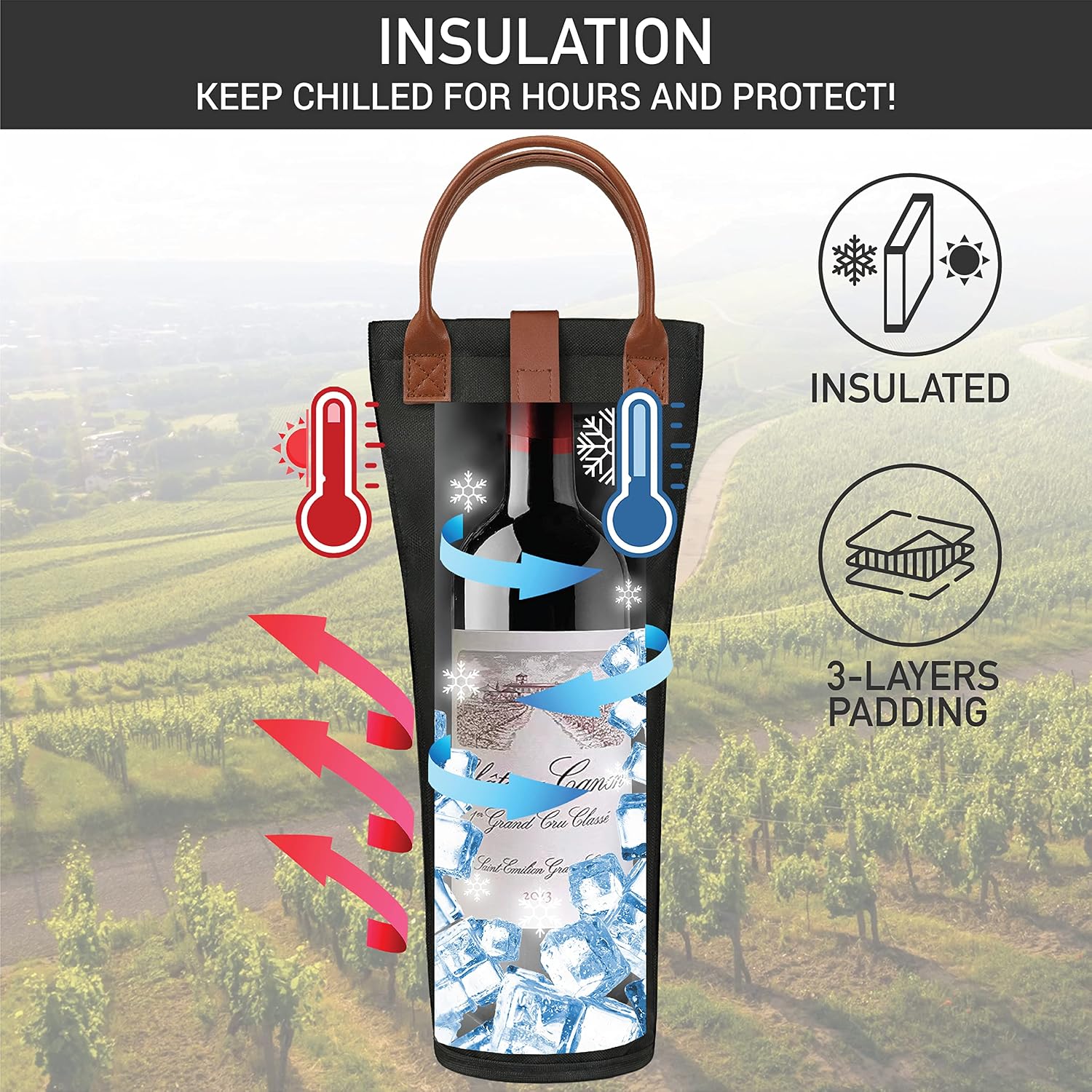
Welcome — and if you’re here because you need to buy, gift, or stock up on single-bottle wine totes and you’re tired of vague “just pick one that looks cute” advice, this guide is for you. A single-bottle wine tote is exactly what it sounds like: a bag, sleeve, or structured carrier designed to hold one standard 750 ml wine bottle. They exist at every price point, from $14 neoprene sleeves at grocery checkout to $165 hand-stitched leather cylinders that outlast the wine inside them. The gap between those two numbers isn’t just aesthetics — it’s insulation performance, gifting presentation, durability over dozens of uses, and what the recipient feels when they unwrap it. This guide maps the full range, names tradeoffs explicitly, shows you the math on cost-per-use, and ends with a clear decision rule so you walk away knowing exactly which tier is right for your situation.
The Four Tiers, Defined
Before comparing products, it helps to name the tiers cleanly. Every single-bottle tote on the market lands in one of these four buckets:
Tier 1 — Functional Everyday ($12–$25). Neoprene or canvas sleeves, minimal structure, usually a zipper top and a simple handle. Think Wine Enthusiast’s neoprene bottle totes or the plain canvas options from Crate & Barrel’s house line. These are grocery-run carriers and “I’m showing up to a friend’s dinner” totes. They protect against minor temperature swings and light bumps. Owners report they’re reliably functional but feel disposable over time — the zipper pull is where failure usually shows up first.
Tier 2 — Elevated Everyday / Entry Gift ($30–$60). Waxed canvas, heavier cotton canvas, or coated nylon with reinforced stitching and a more considered handle. This is where brands like Corkpops and Wine Enthusiast’s linen-blend carriers sit. The presentation improves meaningfully: real rivets, leather handle wraps, printed liners. Reviewers at The Spruce Eats consistently note this tier as the sweet spot for “I want something that feels intentional without overthinking it.”
Tier 3 — Gift-First / Premium Function ($65–$110). Structured insulated carriers in full-grain or bonded leather, often with snap closures, embossed branding, or gift-box packaging. Twine & Todd’s single-bottle carriers and comparable offerings from Uncommon Goods live here. Good Housekeeping’s gift-guide coverage repeatedly flags this tier as the most reliable for “wow” gifting moments — the weight of the carrier signals quality before the recipient even sees the bottle inside.
Tier 4 — Collector / Keepsake ($120–$165+). Full-grain leather, hand-stitched construction, precision-molded insulated interior, hardware in brushed brass or oxidized steel. Picnic Time’s Heritage Collection single-bottle carrier and Coravin’s travel sleeve accessories occupy this space. Real Simple’s gift-guide editors describe these as “heirloom-adjacent” — the kind of thing serious oenophiles keep in rotation for years. The wine is almost secondary to the object itself.
The Numbers That Actually Matter
Before going deeper on each tier, here’s the math that should anchor your decision:
| Tier | Price Range | Est. Uses Before Replacement | Cost Per Use |
|---|---|---|---|
| Functional Everyday | $14–$25 | ~30–60 | $0.25–$0.80 |
| Elevated Everyday | $30–$60 | ~80–150 | $0.20–$0.75 |
| Gift-First / Premium | $65–$110 | ~150–300+ | $0.22–$0.73 |
| Collector / Keepsake | $120–$165 | 300–500+ | $0.24–$0.55 |
The cost-per-use math across Tiers 2, 3, and 4 is surprisingly flat once you factor in realistic longevity. Where the tiers truly diverge is in gifting perception value — the felt quality at unboxing — and in insulation performance, which matters when the bottle needs to stay cold for more than 45 minutes.
Where the Tradeoffs Actually Bite
Insulation: The 90-Minute Problem
If your use case involves carrying a bottle from a wine shop to a picnic that’s 90+ minutes away, insulation quality becomes a load-bearing spec. Wine Enthusiast’s editorial buying guides draw a clear line: basic neoprene sleeves (Tier 1) slow temperature rise by roughly 20–30 minutes versus no sleeve at all, while properly insulated structured carriers (Tiers 3–4 with closed-cell foam or vacuum-panel lining) can hold temperature for two to three hours under normal outdoor conditions. Manufacturer specs on Tier 4 carriers — specifically the Picnic Time Heritage line — claim four-hour performance in their published product documentation.
The tradeoff: Tier 1 neoprene is fine for a 20-minute Uber ride. If you’re picnicking, hiking to a rooftop, or transporting a bottle that’s already at serving temperature to a dinner party across town, Tier 3 or 4 is doing real thermal work.
Presentation: The Unboxing Moment
For gifting contexts — and per brides.com’s wedding gift trend coverage, single-bottle leather totes remain a top-performing personalized gift category in 2025–2026 — the carrier is part of the gift. Owners across multiple review aggregations (as surveyed in Apartment Therapy’s gift-guide roundups) consistently note that Tier 1 and Tier 2 totes, when given as gifts, register as “functional” rather than “special.” Tier 3 changes the dynamic: structured leather with snap closures and gift-box packaging creates a standalone object the recipient actually keeps. Tier 4 makes the carrier the hero — the wine inside is almost a bonus.
The tradeoff: If the gift recipient is going to use the tote themselves, Tier 3 is the smart play. If the tote is the statement — for a wedding party member, a client relationship moment, or a milestone birthday — Tier 4 earns its price.
Monogramming and Personalization
This is where knowing your vendor matters. Tier 2 canvas totes are the easiest to embroider, and turnaround from boutique personalization shops is typically five to seven business days. Tier 3 leather carriers accept embossing well, but not all manufacturers offer it directly — buyers sourcing from Uncommon Goods or Twine & Todd should confirm personalization options at checkout rather than assuming.
Tier 4 carriers present a different challenge: the structured leather is often treated or finished in ways that complicate post-purchase personalization. Real Simple’s personalized gift coverage notes that buyers seeking monogrammed Tier 4 totes should order through the manufacturer’s own personalization program rather than taking a finished carrier to a local embosser.
The tradeoff: If personalization is non-negotiable, Tier 2–3 is operationally simpler and faster. Tier 4 with personalization requires lead time and direct-manufacturer ordering.
Product Signals Worth Knowing
Without claiming to have physically tested any of these, here’s what published specs and aggregated owner reviews consistently surface:
Tier 1 to watch: Wine Enthusiast’s neoprene single-bottle sleeve earns consistent praise for its tight mouth opening (which prevents the bottle from slipping) and its machine-washable construction. Owners report it survives 50+ washes without delamination — unusual for this price tier.
Tier 2 to watch: Corkpops’ waxed canvas single-bottle tote gets repeated mentions in The Spruce Eats’ category roundups for handle durability. The stitched leather handle wrap has a notably longer reported lifespan than competitors using fused bonding.
Tier 3 to watch: Twine & Todd’s structured leather single-bottle carrier — available at Uncommon Goods — consistently leads gifting-category search intent, and owners note the interior padded insert fits both standard 750 ml Bordeaux-style bottles and slightly wider Burgundy-style bottles without slipping. That bottle-shape flexibility matters more than most buyers anticipate.
Tier 4 to watch: Picnic Time’s Heritage Collection single-bottle carrier is the most-cited option in Good Housekeeping’s premium wine accessory coverage. Published specs show full-grain leather exterior, stainless hardware, and an inner sleeve rated for four-hour thermal performance. The reported durability from long-run owners (five to eight years of active use) is what justifies the $150+ price point.
The Decision Rule
If you’ve read this far, you likely have a specific decision pending. Here’s the framework:
If you need a reliable daily carrier for yourself and budget is the priority → Tier 1. The Wine Enthusiast neoprene sleeve at $14–$18 does the job. Replace it annually if needed — the cost-per-use math still works.
If you want something that feels considered without a major spend → Tier 2. The $35–$55 waxed canvas options look intentional, last longer than neoprene, and photograph well if you’re bringing a bottle to a gathering where presentation matters socially.
If you’re buying a gift for a wedding, bachelorette, milestone birthday, or corporate relationship → Tier 3. The $65–$110 range is where gifting ROI peaks. The carrier feels like a real object, personalization is straightforward, and the recipient actually keeps and uses it. Per Apartment Therapy’s gift roundups, this tier has the highest “still using it a year later” rate among wine accessory gifts.
If the recipient is a serious collector, the occasion is a milestone, or you want the carrier to be the statement → Tier 4. The $120–$165 investment is justified when the tote itself is the gift, not just the delivery mechanism. For corporate client gifting at the premium tier, this is also where hospitality professionals consistently land when the relationship warrants it.
If insulation performance is the deciding factor — you’re transporting a prized bottle across town in summer heat, or you need it at serving temperature after a two-hour outdoor event — skip Tier 1 entirely and start at Tier 3.
One last signal worth naming: the best single-bottle tote you can buy is the one that matches the occasion’s actual emotional register. A $165 leather carrier handed to a casual work colleague at a team lunch reads as awkward overreach. A $14 neoprene sleeve tucked into a wedding gift bag reads as an afterthought. Getting the tier right is the real skill here — and now you have the framework to do it.